
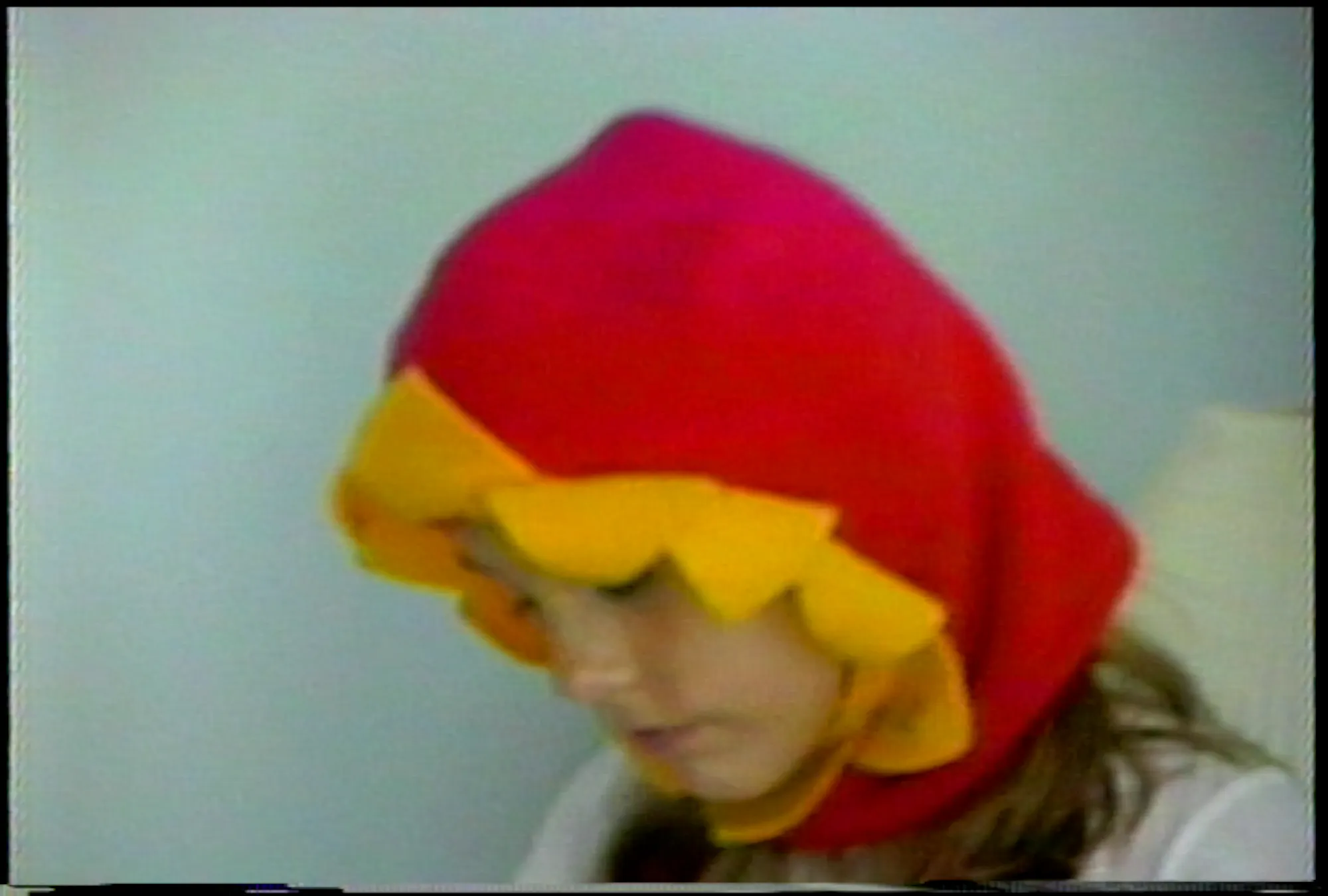
you see the thing of the thing is is
you see the thing of the thing is is
Locky Morris
Liz Vitlin
When I think of Liz and Locky I think of scanning.
I think of finding.
I think of collecting.
I think of looping.
I think a conversation is an evolving composition.
I think of repetition, not to repeat oneself, but to contain oneself.
I think of the prefix “re-”, meaning again, back, or anew. It is added to verbs or nouns to indicate that an action is being repeated (e.g., redo) or to signify a return to a previous state or place (e.g., return, reclaim)
I think of routine as religion.
I think of the digital archive as a landscape.
I think of thumbnails, QuickTime players, loading, storage. I think of lists, lists of words, lists of images, lists of titles with machine generated names including DSC. IMG, 2122, 003234.
I think of provisional titles like Bag Flip iPhone Landscape.
I think video is the best way to extend a memory's surface, although it would be much easier if the camera was built into our eyes.
I think of the distance of memory. The distance is huge, expansive, things remembered become unrecognizable.
I think of my parents, of how they shaped me and how they could only shape me to a certain point. I think of how I, in turn, changed them. I think of Thomas describing becoming a father as cataclysmic and Chris telling me that a child reorients every aspect of your life.
I think of Liz's father, a hardware engineer from the Soviet Union, making her a personalized computer when she was eight.
I think of Locky’s father fashioning him a toy from a bicycle wheel and a length of wire pulled from a heap of scrap on Derry Quay as they passed by one day when he was six.
I think of Grasmere and Dove’s cottage, and a cat named Bumble walking the hills. It is my childhood, and I remember it through a mixture of digicam videos and point and shoot photos, but also my bodily memory.
I think of the revelation of boredom, not the revolution of boredom.
I think of everyday life, the practice of everyday life, and the potential reaffirmation of daily life that a gallery can help you formalize. The gallery acting as a fridge to keep the shifty thing alive still.
I think of foraging for fragile states of balance.
I think of boundaries, but not borders.
I think of inherited structures and daydream of how to leave them.
I think of movement, being in movement, performative movement, dramatic movement, anatomical movement, comedic movement. I have been thinking about Peter Sellers.
I think of Monty Python’s The Ministry of Silly Walks, and to mock is to undermine, to undermine is to destabilize.
I think peak southwesterly gusts are reliable choreographers.
I think dance first, think later.
I think of something flickering.
I think mimicking is a form of protection, performing something, but at a distance.
I think of Locky’s spectrum of gesture, nudging to resolve. The untouched. The staging. The involved. Get out of the way! Do what you want! Try not to jinx things!
I think of objects, like children, on the loose, unburdened by societal responsibilities.
I think you have to have eyes on the back of your head.
I think of the phasing that occurs between two asynchronous loops. Where a beginning is not locatable, where a transition in not locatable. Instead, freefall, limbo, purgatory.
I think of Milford Graves, the polyrhythmic free inducer, playing two different rhythms at the same time.
I think of Kenneth Koch’s In Bed.
I think of Walter Benn Michael’s The Shape of the Signifier. He references a sci-fi novel where the main character walks the shores of Mars. And as the water breaks on the shore, lines from William Wordsworth’s poem begin to crystalize.
A slumber did my spirit seal;
I had no human fears.
She seemed a thing that could not feel
The touch of earthly year.
I think of the correspondence between Joseph Cornell and Mina Loy, Transatlantic friendship.
I think of Nancy Lupo’s emails about Greenland, documenta 12 emails, I think of Park McArthur’s emails, I think of Guy Debord’s letters to his rotating gang of situationists.
I think of Sara Deraedt’s show at the Art Institute of Chicago, of ears, of Isa Genzken.
I think of Madonna.
I think of the magpie.
I think Art Povera wasn’t poor enough.
I think that language often carries cultural and conceptual baggage and crude expression is a necessary way to lighten the load.
I think you’re going to want to get her a computer.
I think of being in a band.
I think of school.
I don’t think too much about contemporary art.
Mark O’Gorman
Curated by Mark O’Gorman in collaboration with Met him pike hoses
Gertie
400 North Peoria Street
Chicago
Opening reception:
Saturday 11 April
2–5pm
Exhibition until 24 May
For decades, Locky Morris is a key and influential voice in Irish art. Renowned for his early work that explicitly dealt with the conflict in the North of Ireland – most notably from a socially-embedded perspective in his native Derry – he has gone on to develop a working vocabulary that moves fluidly between the personal, public and political. While still informed by the complexities and intricacies of his immediate landscape, today his practice extends across video, sound, photography and gallery installations, with a fascination for what confronts him in the often chaotic details of the everyday.
A series of his video artworks make their American debut alongside building dialogue with artist Liz Vitlin and the local Chicago art scene. you see the thing of the thing is is will give form to a sustained and growing conversation between Mark O’Gorman and Julian Van Der Moere, which began in 2024. This exhibition continues the curatorial interests of both Mark and Julian, whose exhibition programmes in the last decade have focused on site-specific work and detailed conversational approaches with artists, bringing together carefully-considered yet surprising outcomes.
Image: Liz Vitlin, Nobody Knows Me, 2026